


The short answer
Buy TPE if you want the softest, most yielding feel at the lowest price and you're willing to do regular upkeep. Buy silicone if you want finer detail, less maintenance and a doll that holds up for years, and you can pay roughly 1.5–3× more. Buy a hybrid (silicone head, TPE body) if you want a realistic face on a budget.
- Rosemary Doll — our best-overall store, on the Starpery, Zelex and FanReal lists. Review
- Better Love Doll — best value, with a 30-day return window on unused dolls; pay by PayPal. Review
- Silicon Wives — US-stock dolls that ship in days. Review
Our main guide scores every major US-facing distributor on authenticity, value, customization, delivery and support.
See the best vendors of 2026What the materials are
TPE stands for thermoplastic elastomer — a blend of plastic and rubber that becomes soft and stretchy when cured. It's the same family of material used in soft phone cases and some kitchen tools. In dolls it's valued for its give and bounce, and because it's cheap to mould.
Silicone in dolls is platinum-cure silicone, a two-part rubber that cures into a stable, non-porous material. It's used in medical implants and high-end special-effects prosthetics for the same reasons it's used here: it holds fine surface detail, doesn't break down with heat or time, and doesn't absorb liquids.
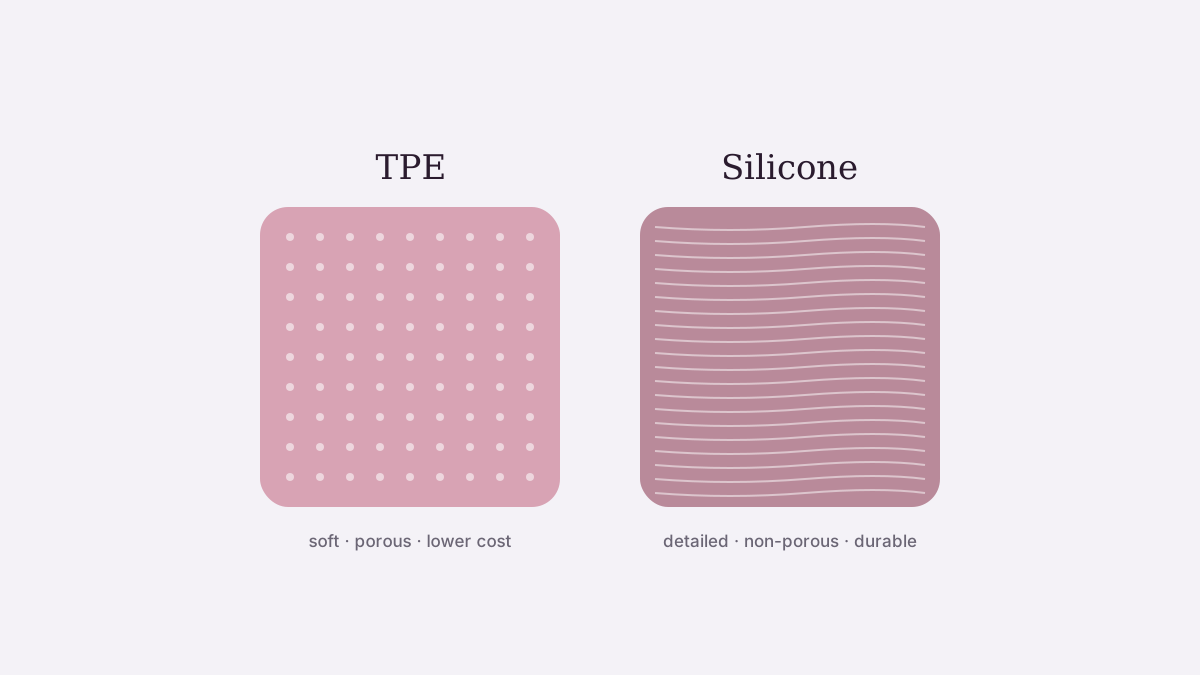
Side-by-side comparison
| Factor | TPE | Silicone |
|---|---|---|
| Softness | Very soft, high bounce | Firmer; premium grades are softer than older silicone |
| Surface detail | Smooth, less fine texture | Fine texture, veins, makeup that stays put |
| Porosity | Porous — absorbs moisture and oil, can stain | Non-porous — easy to clean, resists staining |
| Heat tolerance | Low — avoid heaters above body temperature, hot water and sun | High — tolerates warm water and built-in heating |
| Maintenance | Regular powdering, careful drying, oil-bleed wiping | Light cleaning; occasional powdering |
| Lifespan with care | Roughly 2–5 years before noticeable wear | Often 5–10+ years |
| Weight (full-size) | Typically 60–90 lb | Typically 60–100 lb; similar at the same size |
| Typical US price | $800–$2,500 | $2,000–$6,000+ |
| Repairability | Easy with TPE glue; tears are common but fixable | Harder; needs silicone adhesive and patience |
Feel and realism
These two qualities pull in opposite directions, which is why the choice exists at all. TPE is softer to the touch and moves more like flesh when pressed. Silicone is firmer, but it can be moulded with far finer detail — realistic skin texture, defined knuckles, painted features that don't rub off. Manufacturers have narrowed the gap from both sides: newer soft-silicone formulations are noticeably softer than silicone from a few years ago, and premium TPE blends hold more detail than budget TPE. Still, if feel is your top priority, TPE wins; if realism in photos and up close is your priority, silicone wins.
Durability and maintenance
This is where silicone earns its price. Because TPE is porous, it absorbs water and body oils, which is why owners dust it with cornstarch or renewal powder after cleaning and why dark clothing can transfer dye into it permanently. TPE also "sweats" a thin film of mineral oil over time that needs wiping. Heat is its enemy: warm water above body temperature can soften it, and direct sun can deform it.
Silicone has none of those problems. It can be washed with warm water and mild soap, dried, and put away. Dye transfer is far less likely. It tolerates built-in heating systems and the kind of warm cleaning routine that would damage TPE. The trade-off is that silicone tears are harder to repair, and silicone is less forgiving of hard knocks on fingers and toes.
Whichever material you choose, the stand and the way the doll is stored matter more for lifespan than the material itself. Pressure points from lying in one position for months will flatten TPE and can mark silicone.
Weight
Full-size dolls of either material are heavy, often 60–100 lb, because of the steel skeleton and the volume of material. Weight scales with height and body type, not materially with TPE versus silicone. If weight is a concern, look at shorter models, slim builds, or the "lightweight" lines some manufacturers now offer, which hollow parts of the body to shave 20–30% off.
Price
In the US market, authentic full-size TPE dolls from major factories usually sell for $800 to $2,500 depending on size and vendor. Silicone from the same factories typically starts around $2,000 and runs to $6,000 or more for premium brands with movable jaws, implanted hair and detailed paintwork. Hybrids sit in between. If a listing is dramatically below those ranges for a named brand, treat it as a warning sign — see our guide to avoiding counterfeit dolls.
Hybrid dolls
A hybrid pairs a silicone head with a TPE body. You get the realistic face, which is where detail matters most and where TPE's limitations are most visible, while keeping the softer body and lower price. Most major distributors let you mix a silicone head onto a TPE body at checkout, sometimes across brands. It's the configuration we recommend most often to first-time buyers who care about realism but have a mid-range budget.
Which one is right for you
- First doll, budget under $2,000: TPE, from an authorized vendor, with a cleaning kit included.
- Realism and low upkeep, budget $2,000+: silicone.
- Realistic face, mid budget: hybrid.
- Plan to use heating or warm cleaning routines: silicone.
- Want to photograph or display it: silicone, for detail and for paint that stays put.
Once you've decided, the next question is who to buy from. Our vendor rankings cover which distributors are authorized for which brands, what they charge, and how they ship.
FAQ
Is TPE safe?
TPE from established manufacturers is a phthalate-free, body-safe elastomer. Because it's porous, hygiene depends on cleaning and thorough drying. Unbranded dolls from unknown factories are the concern, not the material itself.
Does silicone feel hard?
Older silicone did. Current soft-silicone formulations from the major brands are much closer to TPE in give, though still firmer. If you can, compare the manufacturer's stated shore hardness between models.
Can I upgrade a TPE doll to a silicone head later?
Usually yes, if the neck connector matches. Most vendors sell heads separately and will confirm compatibility.
Which lasts longer?
Silicone, by a wide margin, with the same care. TPE's lifespan depends heavily on how carefully it's cleaned, dried, powdered and stored.
Sources
- SD Canada help center, "TPE vs silicone" — sdcanada.helpscoutdocs.com
- Safe Sex Dolls help center, "What's the difference between silicone and TPE?" — safesexdolls.freshdesk.com
- JingSourcing, "Sex doll suppliers" (ex-factory TPE vs silicone costs) — jingsourcing.com
- Rosemary Doll, material guidance on product pages — rosemarydoll.com
- Manufacturer specifications: Irontech (lightweight silicone bodies), Starpery (Weight Reduction 4.x), Zelex (SLE), SY Doll (one-year limited warranty).
- Vendor pricing for TPE, hybrid and silicone configurations, accessed November 2026 (see our cost guide).